Acid in an Alkaline Land: How Decades of Conifer Needles Acidify Pockets of Sandy Soil on Limestone-rich Manitoulin Island
Introduction: Soil Acidity and Alkalinity
Geology shapes where plant species grow and the diversity of those communities. Soil chemistry is strongly influenced by the geology below. Soil acidity or alkalinity is one important chemical property measured by pH. Soils with a pH below 7 are acidic (e.g., pH of 3). Soils above 7 (e.g., pH of 8) are alkaline. Neutral soil has a pH of 7 (Image 1).
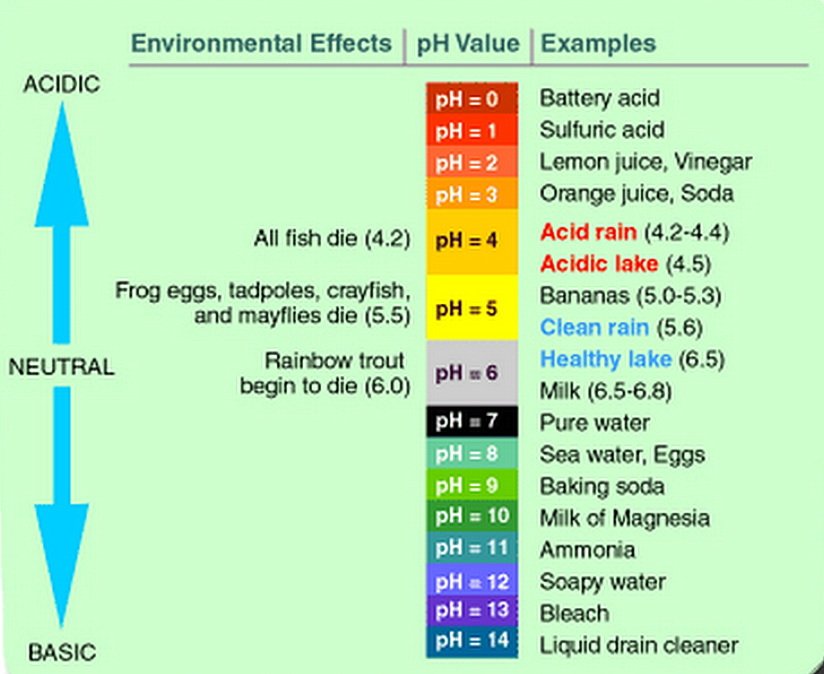
Image 1: Simple pH scale that illustrates the pH of some familiar items. Image: United States Geological Survey (USGS): https://www.usgs.gov/media/images/ph-scale
Acidic soils form when the hydrogen ion concentration (H+) increases in soil, causing the pH to drop below 7. Conversely, soils rich in elements called base cations, like calcium, magnesium or potassium, tend to be alkaline with a pH greater than 7.
Acidic and alkaline soils support different plant communities. For example, Cypripedium acaule (pink lady’s slipper orchid; Image 2a) is common in northern parts of Ontario, on the acidic soil of the Canadian boreal forest (Image 3); conversely, Cypripedium parviflorum (yellow lady's slipper’ Image 2b) favours the alkaline soil that developed on limestone and dolostone rock in southern to central Ontario (Image 3). Botanists call an acid-loving plant species a calcifuge. A lime-loving plant species is called a calcicole. Soil pH also affects the activity and diversity of soil microbes, so a change in soil pH is often accompanied by a change in plant and micro-organism species. In addition to changing the plant and microbe communities, changes in soil pH also affect the availability of plant nutrients. Below about pH 5.5 or above roughly pH 7.5, some nutrients become locked out and inaccessible to the plants. Changes in soil pH may also contribute to the degradation of environmental quality.
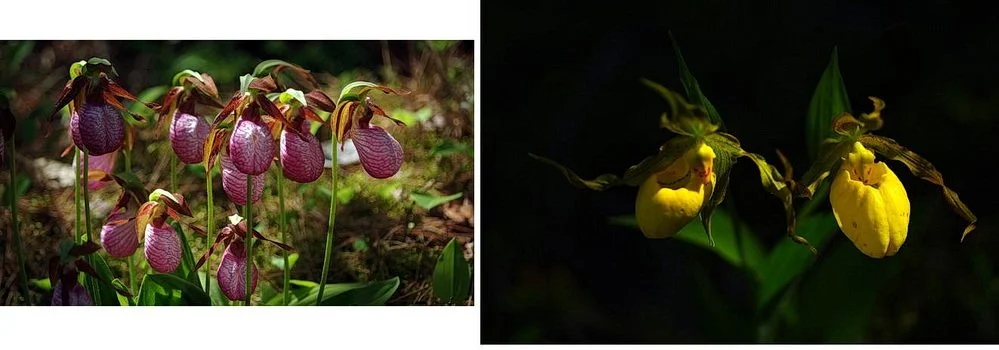
Image 2: Left 2a: Pink lady’s slipper (vvv); Right (2b): Yellow lady’s slipper (xxx). Images by Andy Fyon.

Image 3: Distribution of pink and yellow lady’s slipper orchids across souther and parts of northern Ontario, Canada. Data from iNaturalist.
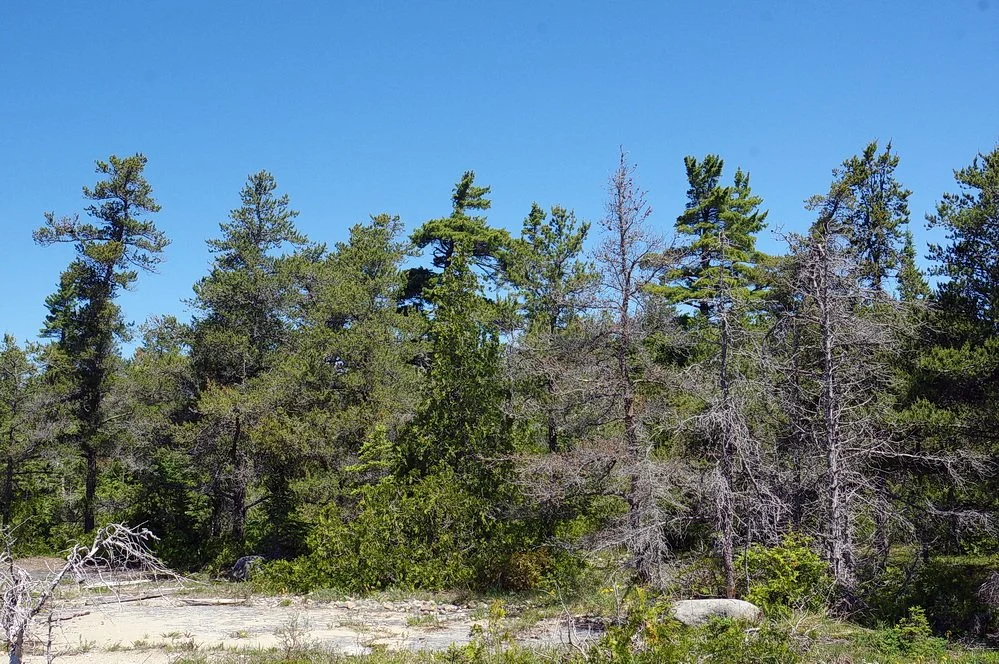
In summer 2026, I revisited the Burnt Island alvar, within Queen Elizabeth The Queen Mother Mnidoo Mnissing Provincial Park, Manitoulin Island. An alvar is an uncommon habitat where thin soil overlies flat-lying limestone and dolostone. Adjacent to part of the Burnt Island alvar, I noted the localized presence of some plant species that favour acidic soils: a) Cypripedium acaule (pink lady's slipper) (Image 2a); b) Cornus canadensis (bunchberry) (Image 4a); c) Chimaphila umbellata (pipsissewa) (Image 4b); d) Linnaea borealis (twinflower) (Image 5a); and e) Lysimachia borealis (northern starflower) (Image 5b). They were growing in sandy soil on the floor of a coniferous forest stand consisting of Pinus banksiana (jack pine), Picea glauca (white spruce) and Abies balsamea (balsam fir) on the edge of the alvar. I was struck by this plant community because Manitoulin Island is dominated by calcareous limestone and dolostone bedrock. Surely those calcareous rocks would buffer the soil and keep it from becoming acidic? The presence of these acid-tolerant and acid-loving plant species caused me to wonder what processes acidified the local sandy soil.
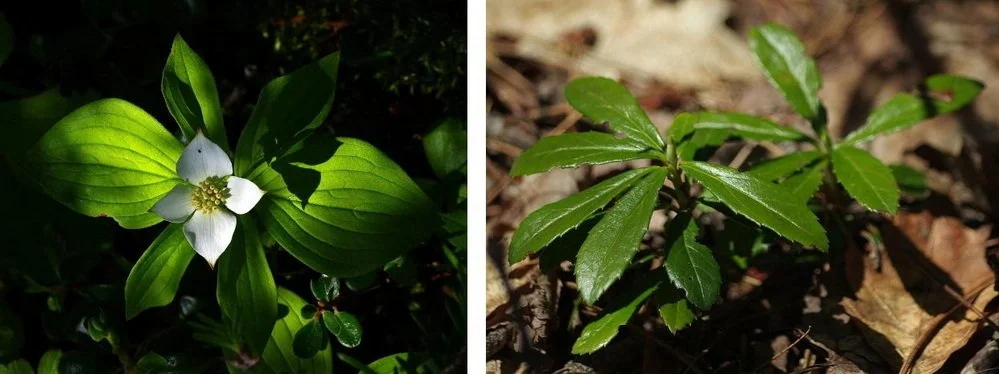
Image 4: Two plant species that grow on acidic soil. 4a (left): Bunchberry (Cornus canadensis). and 4b (right): Pipsissewa (Chimaphila umbellata). Both photos composed by Andy Fyon, Burnt Island alvar, Manitoulin Island, Ontario, Canada, June 22, 2026.
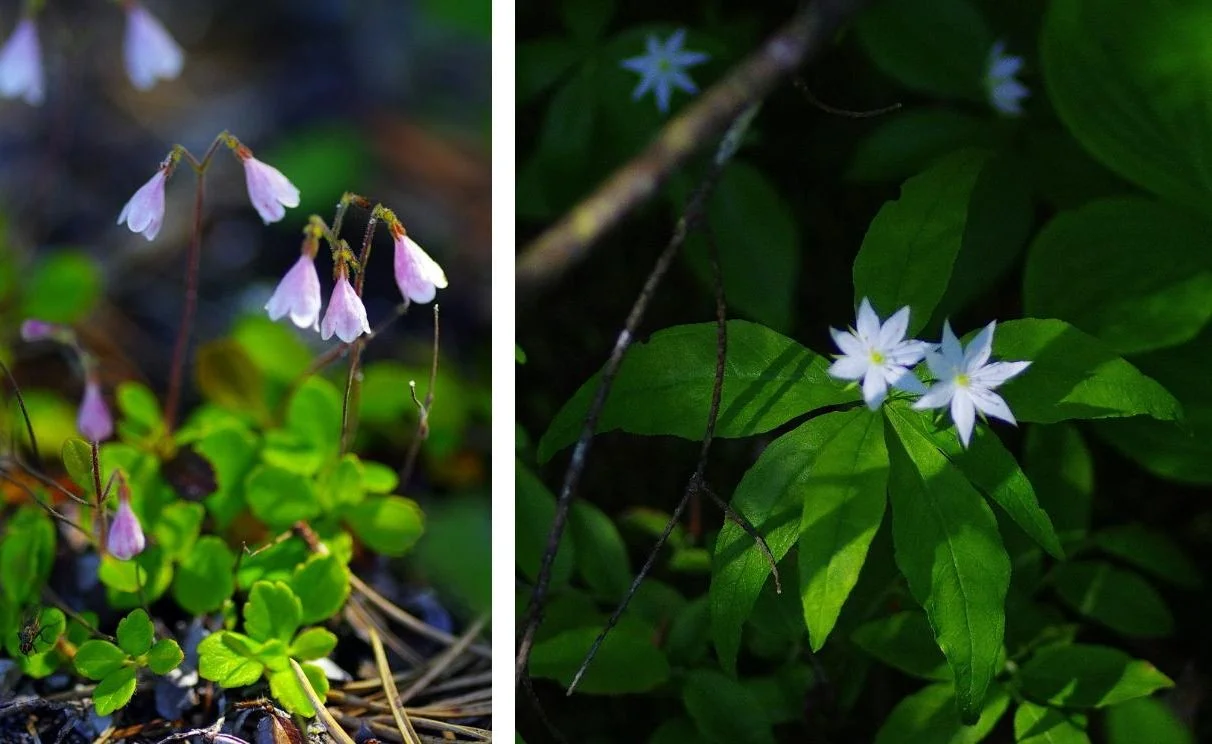
Image 5: Two plant species that grow on acidic soil. 5a (left): Twinflower (Linnaea borealis) and 5b (right): Northern Starflower (Lysimachia borealis). Both photos composed by Andy Fyon, Burnt Island alvar, Manitoulin Island, Ontario, Canada, June 22, 2026.
In this note, I describe several processes that acidify soil, including the breakdown of conifer needles. Some technical references state that the breakdown of conifer needles acidifies soil. Others call that a myth. Are these divergent conclusions the result of poor science or measuring different soil parameters?
Simple Geology of Manitoulin Island near Burnt Island Alvar
Manitoulin Island consists predominantly of calcareous limestone and dolostone (Image 6). Parts of the bedrock near Burnt Island are covered by lacustrine sand, gravelly sand, and gravel deposits (references 1 and 2). that accumulated as ancient beaches, bars, spits, and sand dunes near the shores of glacial Lake Algonquin, during the Nipissing stage, about 4,500 years ago (Image 2). Lake Algonquin started to form at the end of the last ice age and you can consider it to be ancestral Lake Huron.

Image 6: A map that shows the location of the Burnt Island alvar and the very simplified bedrock geology of Manitoulin Island. Coloured areas labelled as #1 are predominantly limestone. Coloured areas labelled #2 are mostly of dolostone. Image source: Georgian Bay Geopark: https://planetrocks.utsc.utoronto.ca/trips/Paleozoic_Coast.html
Soil Nutrient Storehouse
Soil is a natural storehouse for plant nutrients. Some plant nutrients, like calcium, magnesium and potassium, are called base cations. The elements carry a positive charge and are essential to the growth of most plants. They are also important because they neutralize acids. The more base cations there are in a soil, the less likely is the soil to become acidic.
The soil’s ability to store these base cations is called cation exchange capacity (CEC). Clay and organic matter in soil are the primary materials that hold the base cations. Sandy soil has very low concentrations of base cations. Organic-rich soil contains up to 30 times more base cations than sand, which explains why pure quartz, sand soil does not have the ability to neutralize acid.
Processes: Alkaline or Acidic Soil
Changes in soil pH may be caused by natural processes and human activities:
a) Reaction between granular limestone and dolostone rock and acid: Limestone and dolostone are made up of carbonate minerals, like calcite (CaCO₃) and dolomite (CaMg(CO₃)₂). Granular rock pieces have both a high CEC and a large, reactive surface area that together neutralize acids. Limestone and dolostone create alkaline soil, not acidic soil.
b) Reaction between water and limestone and dolostone: Surface water and groundwater that flow over or through limestone or dolostone react with and dissolve the rock. That process releases calcium and magnesium into the water, which becomes alkaline. Alkaline water has a high CEC capable of neutralizing acids in the soil. For that reason, soils saturated with alkaline water or soils that lie within the alkaline groundwater table are not likely to become acidic.
c) Soil thickness above a calcareous rock: A thick soil layer that blankets calcareous bedrock prevents surface organic acids from interacting with, and being neutralized by, the rock. Similarly, a thick soil blanket prevents mixing between surface acids and deeply buried alkaline groundwater, which prevents the groundwater from neutralizing the acid. In these cases, acidification of surface soil may occur.
d) Reaction between water and quartz sand: Pure quartz (SiO₂) sand beaches or sand dunes have no base cations and a very low CEC. For those reasons, pure quartz sand cannot neutralize acids. Therefore, sandy soil is vulnerable to acidification, especially where decomposition of surface vegetation releases organic acids into the surface environment.
e) Leaching: The Burnt Island alvar experiences a climate influenced by Lake Huron, which includes heavy precipitation. Heavy precipitation is capable of leaching base cations from the soil. Rich, organic soil is less susceptible to leaching because its soil structure is less permeable compared to sand. Sandy soil is permeable and precipitation passes through quickly, leaching available base cations. Once the soil is leached of base cations, there is nothing to neutralize the acids and the soil becomes acidic.
f) Root respiration: plants roots release CO2 which increases the concentration of carbonic acid (H2CO3) in the soil and subsequent leaching.
g) Vegetation removal: Soil acidification is accelerated when vegetation is removed from an area by harvesting or clearcut logging because: a) vegetation is a source of soil-based base cations; and b) vegetation loss decreases soil organic matter. Vegetation removal reduces the soil’s ability to neutralize soil acids, resulting in soil acidification.
h) Forest fires: The impact of fire on soil pH is complex and depends on several factors, including fire intensity, soil type, local climate, time, and soil type (e.g., sandy vs organic-rich). In addition, ash particles can clog soil pores, which leads to rapid removal of ash-based nutrients by surface runoff during precipitation. Large forest fires are known to have affected Manitoulin Island over the last 400 years. Might these forest fires have affected soil acidity over the short term (a month to a few seasons) and long term (hundreds of years)?
Conversion of vegetation to ash during a forest fire increases base cation nutrients in soils, raises soil CEC and alkalinity, and raises soil pH in the short term (University of Alberta reference, Springer reference 1, and Springer reference 2). However, over time, old forest fire soils become acidic when: i) precipitation leaches base cations away; and ii) conifer needles created by a post-fire successional coniferous forest decompose, releasing organic acids and tannins back onto the forest floor as the forest soil slowly returns to its naturally, pre-fire state. Returning to a pre-fire state may take hundreds of years. Fires last burned coniferous forests that grew on the Burnt Island Alvar sandy substrate 100 to 400 years ago. Therefore, it is likely that the short-term, post-fire alkaline-nutrient soil boost passed many years ago and the forest floor soil has returned to its acidic, pre-fire pH.
i) Anthropogenic addition of ammonium (NH4+) fertilizer: Application of ammonium fertilizer to soil is a common farm practice. Excess application of ammonium (NH4+), nitrogen-based fertilizer increases ammonium concentration in the soil. Vegetation uptake of NH4+ causes plant roots to release H+. That acidifies the soil. I shall not consider this process further because it is not likely to have been a factor on the Burnt Island alvar area.
j) Weathering of iron sulphide minerals: Weathering of minerals like pyrite (FeS2) creates acid drainage. If not neutralized, that acid will acidify the soil. I shall not consider this process further because there is no evidence of iron sulphide minerals in the Burnt Island alvar area.
k) Decomposition of conifer needle litter: Compared to deciduous leaves, conifer foliage is high in lignin, resins and waxes. It builds an acidic organic layer on the forest floor called mor humus consisting of evergreen needles and woody debris. Mor humus decomposes slowly, releasing organic humic and fulvic acids that lower the pH. Research shows that pine and spruce forests can reduce surface soil pH from 5.7 to 4.7 over 46 years and spruce plantations can lower soil pH by an average of 1.28 units (Brand et al. 2011). Yet, other studies conclude that is a myth. What accounts for this research divergence?
Elephant in the Room: Acidification by Decomposition of Conifer Needles
Given enough time, decomposition of conifer needles on a low-CEC sandy deposit does acidify the soil. Two arguments support this conclusion:
qualitative observations: conifers naturally thrive in low pH soils and shed needles that cover the soil surface. That leads to the conclusion that conifer trees acidify the soil they prefer;
quantitative: forest fires are often accompanied by a temporary increase in soil alkalinity, CEC and pH. But, after decades or hundreds of years, soil pH drifts back toward acidic values as forest succession unfolds.
Many reputable sources contend soil acidification by conifer needle decomposition is a myth:
PennState College of Agricultural Sciences: The Distinctive Features of Conifers;
University of New Hampshire: Do pine trees and pine needles make soil more acidic?;
Colorado State University Master Gardener: Pine Needle Myths;
The Natural Tree Family: Do Pine Trees or Pine Needles Change the pH of My Soil?;
Master Gardeners of Northern Virginia: Garden Myth Busters! Pine Needle Mulch;
University of Maryland Extension: The Pine-needle Myth: Truth or Bust?.
The acidification myth perspective likely reflects two common conditions of the soils studied. First, the studies address acidification of organic-rich garden soils having active microbe communities. This soil type has a high base cation concentration and therefore, a high CEC. Such soil neutralizes weak organic acids released as the conifer needles decompose. Second, home garden-related observations are short-term, perhaps lasting 50 years or less. Over that time-frame, the pH of organic-rich garden soil is little affected by the decomposition of conifer needles.
These conditions don’t describe most natural forest soil systems, especially sandy soils. On parts of the Burnt Island alvar, low-CEC, sandy soil has not been disrupted for decades to centuries. Sandy soil acidification by humic acids works on a timescale well outside that of the average home garden.
Summary
On parts of the Burnt Island alvar, decades to centuries of conifer needle decomposition is the likely process by which sandy soil was acidified. It is the process that created local conifer forest habitats that support calcifuge plants: a) Cypripedium acaule (pink lady's slipper); b) Cornus canadensis (bunchberry); c) Chimaphila umbellata (pipsissewa); d) Linnaea borealis (twinflower); and e) Lysimachia borealis (northern starflower) within the stands of Pinus banksiana (jack pine), Picea glauca (white spruce) and Abies balsamea (balsam fir).
In summer 2027, I shall apply this insight to seek out other sandy deposits where Cypripedium acaule (pink lady's slipper) may occur.
Additional References:
1: Hoffman, D.W., Wicklund, R.E., and Richards. N.R. (1959): Soil Survey of Manitoulin Island. Report #26, Ontario Soil Survey, 85p.
2: Barnett et al. (1991): Quaternary geology of Ontario, southern sheet; Ontario Geological Survey, Map 2556, scale 1:1,000,000
October 4, 2026
Quisque iaculis facilisis lacinia. Mauris euismod pellentesque tellus sit amet mollis.