Alberta: Hoodoos Near Drumheller
Canada is remarkable for its diverse landscapes. One landscape that amazes me are the badlands of western Canada. They are unusual landscapes that support unusual habitats, which are home to unusual plants, reptiles, animals, and arachnids. It should come as no surprise that badland landscapes sport unusual geological features.
When I visit the western Canada badlands, I set out to find and visit the hoodoos. And avoid the rattle snakes, the scorpions, and the black widow spiders (Photo 1)!
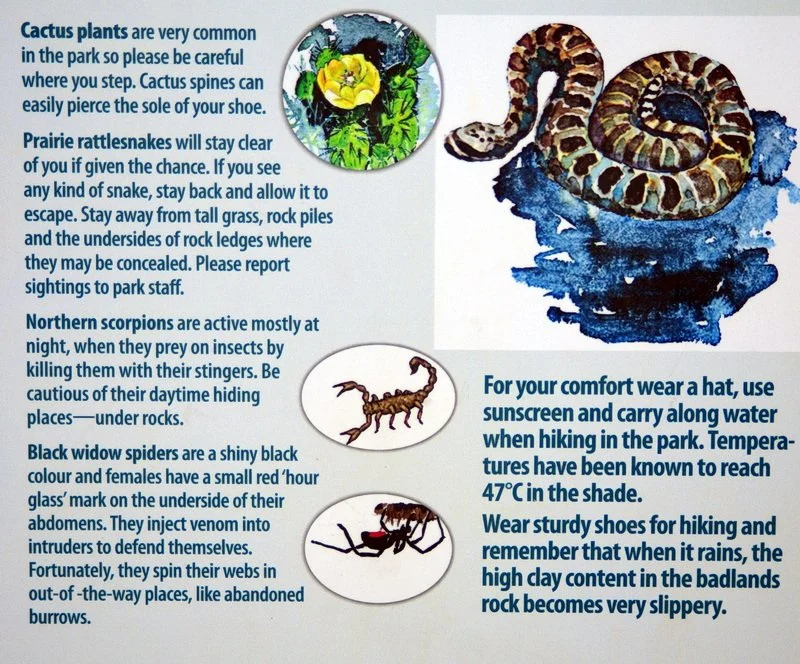
Photo 1: An extract of a sign posted at a trail head in Dinosaur Provincial Park, Alberta, Canada, warning visitors of a few of the exciting wildlife encounters that may be experienced! Despite the warnings, I have never encountered a rattlesnale, northern scorpion, or black widow spider in any western Canadian badland. But, I am cautious and always mindful that I am a visitor in their habit. Image by: Andy Fyon, Dinosaur Provincial Park, Alberta, Canada, Aug. 8, 2019.
A Hoodoo Primer:
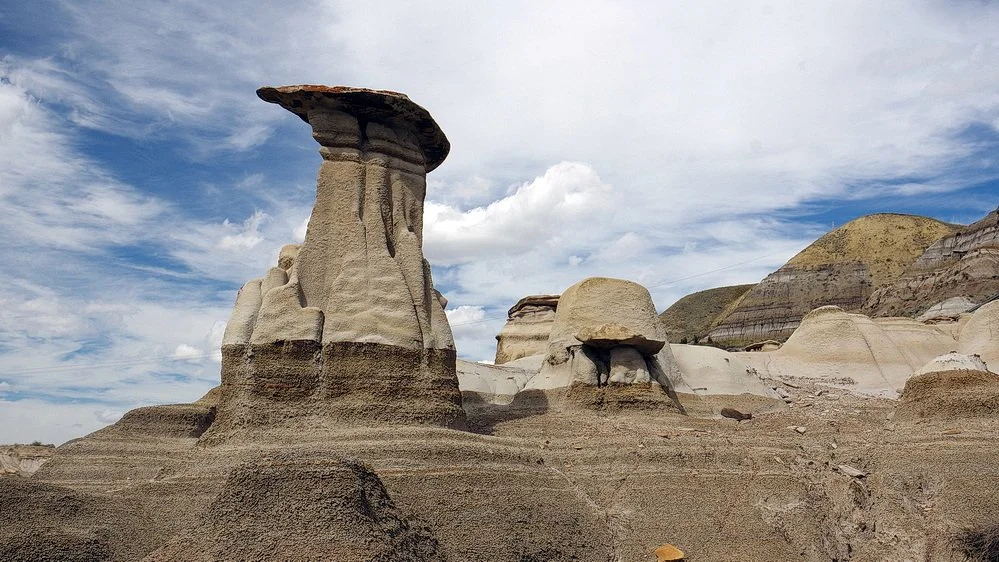
Hoodoos are geological features found most, if not all, of the western Canada’s badland. A hoodoo is an upright column of soft, clay-rich rock that is capped by a harder rock (Photo 2). Hoodoos formed by weathering and erosion. Over time, erosion preferentially removed the softer rock from a landscape. But, in places, a harder cap rock resisted erosion. The result was the creation of the distinctive tall, slender, isolated natural rock column or spire that tapers upwards (Photo 2). The cap, which consists of a harder rock, resists erosion and adds some protection to the softer rock column below.
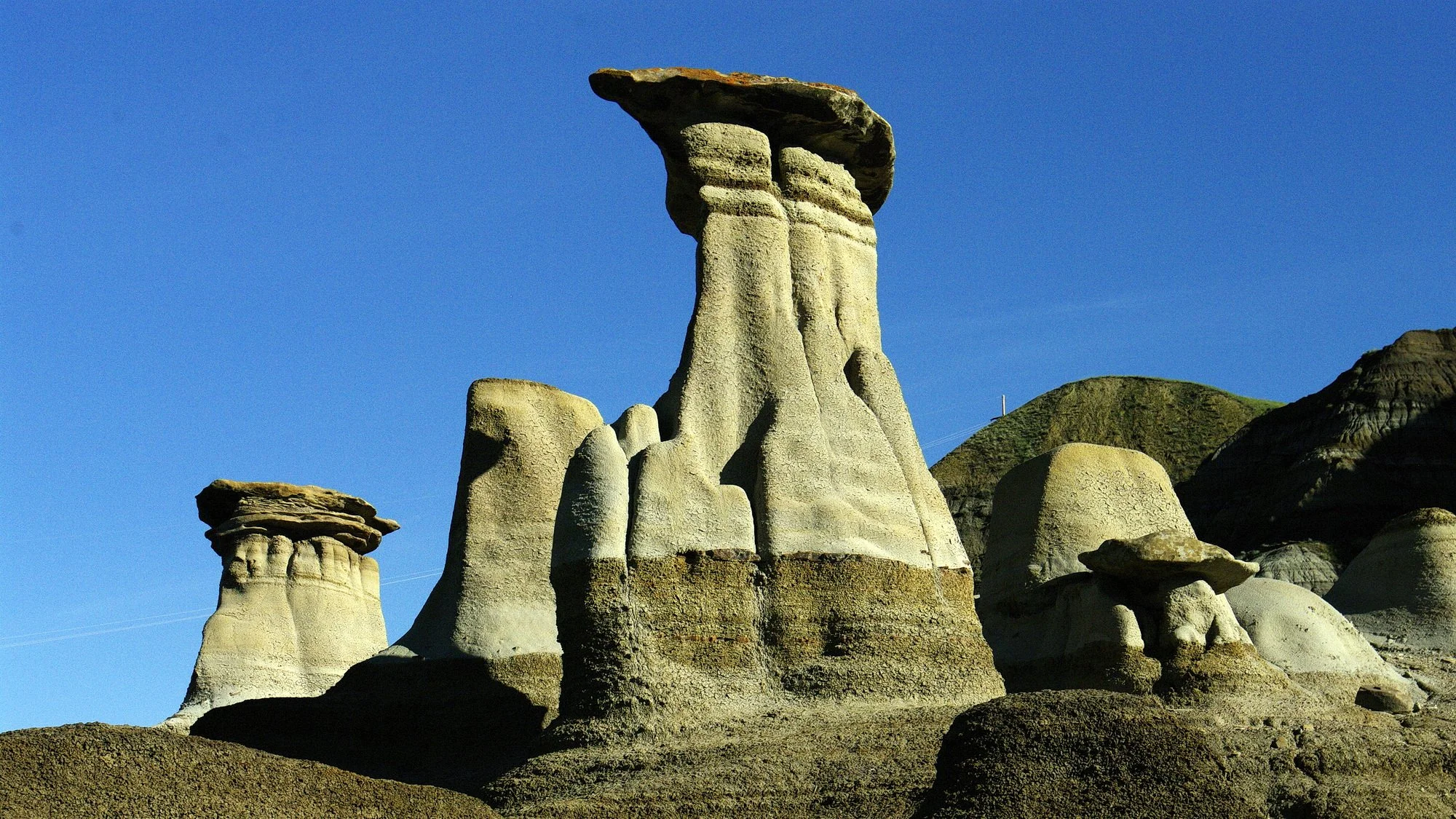
Photo 2: One of the iconic Willow Creek hoodoos, located near Drumheller, showing the classic form of a harder cap sandstone that offers some protection to the softer and more easily eroded column. Location: Willow Creek area, in the Red Deer River valley, near Rosedale, Alberta, June 22/14. Image by Andy Fyon.
A hoodoo may be several tens of metres tall (Photo 3).

Photo 3: Our grandsons (left: Adrien Fyon; right: Brayden Fyon) in front of the very well developed Willow Creek Hoodoos, a popular and excellent location for tourists to become familiar with hoodoos on the badlands. Location: Willow Creek area, in the Red Deer River valley, near Rosedale, Alberta, Aug 11/23. Image by Andy Fyon.
Or a hoodoo may be small, about the height of a human (Photo 4).

Photo 4: Hoodoos occur in all sizes. These ones are about the size of a human. Location: Hoodoos Trail, Red Deer River valley, Alberta, Canada, May 30/19. Image by Andy Fyon.
In the western Canadian badlands, the hoodoo cap generally consists of harder sandstone and the column consists of softer, clay-rich, mudstone or volcanic ash. In many sandstone rock caps, you can see curved or inclined bands that geologists interpret as preserved sedimentary bedding (Photo 5). Geologists call this cross-bedding.
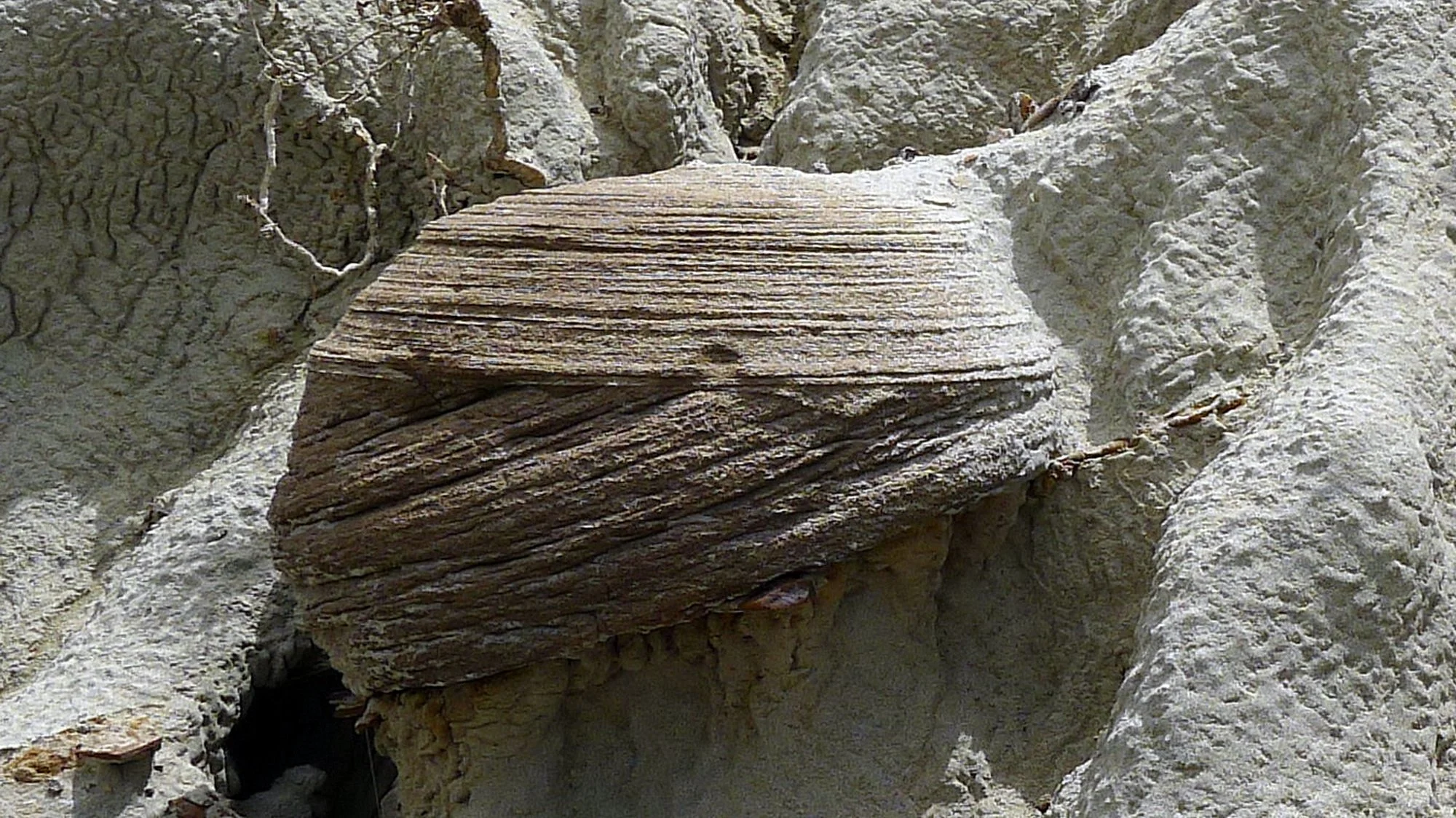
Photo 5: To a geologist, the layers in this harder sandstone cap on top of an emerging hoodoo represent preserved ancient beds of sandy material. The angular shape of the beds, in a bigger context, are called cross-bedding and formed by deposition from an ancient river 70 million years ago! Location: Avonlea badlands, Saskatchewan, Canada, June 11/12. Image by Andy Fyon.
Etymology of the word hoodoo:
Have you ever looked at a geological feature that causes you to say “I see something there - a perhaps a face? I feel something here - perhaps something different or spiritual?” Your feeling may be aligned with the etymology of the word “hoodoo”.
Historically, some sources suggest the word hoodoo is derived related to Voodoo or Hoodoo spirituality, but that derivation is increasingly being discounted in favour of an Indigenous derivation.
Some suggest the word hoodoo is derived from the Southern Paiute First Nation word “oo’doo”, southwestern United States, which describes an object that is scary or inspires fear (Photo 6). Other First Nations consider hoodoos to be petrified remains of ancient beings who had been punished for some sort of misbehavior. The Blackfoot First Nations use the word matapiiksi, meaning “the people” to describe the collection of hoodoos and sandstone columns at Writing-on-stone Provincial Park, a UNESCO World Heritage Site in Alberta, Canada. These explanations certainly ring true for me and are very consistent with the ambiance of the badland landscape.
But, I leave it to you to visit a badland and sit among the hoodoos in the evening as the sun sets.

Photo 6: The origin of the word hoodoo is attributed to First Nations who saw these geological features as something scary or that inspires fear (https://en.wikipedia.org/wiki/Hoodoo_(geology)). To my eye, the shape of this hoodoo resembles the bust of an animal, with its ears back and eyes squinted, ready to take action. Location: badlands in Dinosaur Provincial Park, Alberta, Canada, Aug. 9/19. Image by Andy Fyon.
Andy Fyon, Jan 11, 2026; rev Feb 3/26
Quisque iaculis facilisis lacinia. Mauris euismod pellentesque tellus sit amet mollis.