
Edaphic Factors and Plant Species
Introduction
Have you ever wondered why some plant species occur only in certain geographic areas? Perhaps you are very familiar with the composition and distribution of plant communities within a region, yet you are puzzled by the occurrence of a distinctly different plant community in a small, localized area. The explanation may lie in differences in the underlying geological substrate or landforms. More specifically, the plant communities may differ because the edaphic factors of the localized area differ from those of the surrounding landscape.
Edaphic and Ecological Factors
To better understand edaphic factors, it is helpful to compare them with the more familiar concept of ecology.
Ecology is the study of the relationships among organisms and between organisms and their environment (Begon et al. 2006). It encompasses climatic, biotic, abiotic, and topographic factors that influence the structure and function of ecosystems. Ecological habitats range in scale from a vernal pool to the entire boreal forest and include a wide variety of environments. Ecology integrates substrate-related variables, including geology, with climate, light, moisture regimes, and species interactions to explain patterns of community composition and ecosystem function (Rajakaruna et al., 2024).
In contrast, edaphic factors are the geological substrate-related components of an ecological system. They include substrate texture and structure, geochemical composition, pH, drainage, moisture availability and retention, nutrient availability, and organic matter content (Rajakaruna and Boyd, 2008). Together, these factors strongly influence the distribution, composition, growth, and diversity of plant communities (Rajakaruna et al., 2024).
Edaphic Habitats and Climate
When considering the distribution of plant species, it is important to recognize that climate has a broad regional influence on vegetation. For example, the flora of the subarctic tundra differs markedly from that of the Lake Erie coastal region within Ontario's Carolinian Zone. However, even within a relatively uniform climatic region, localized edaphic habitats may support plant communities that differ dramatically from the surrounding regional flora.
An edaphic habitat is therefore defined primarily by distinctive geological characteristics of its substrate rather than by regional climatic conditions (Rajakaruna et al., 2024). These localized geological differences can create unique environmental conditions that favor specialized plant communities.
Examples of Edaphic Habitats
The serpentinite barrens of the Tablelands in Gros Morne National Park, Newfoundland and Labrador (Photo 1), provide a dramatic example of an edaphic habitat in which an unusual geological substrate restricts the growth of most plant species.

Image 1: Brown-coloured, weathered serpentinite rock of the Tablelands does not support much vegetation. This contrasts with the sedimentary rock, covered in grenn vegetation, which underlies the hills in the distance. This is an iconic example of the edaphic influence on types and distribution of plant species. Photo composed on the Tablelands, Gros Morne National Park, Newfoundland and Labrador, Canada, June 17, 2011. Image by Andy Fyon.
The substrate consists of ultramafic rocks, which include peridotite, dunite, and pyroxenite. Those rocks have been partially altered to serpentinite. These rocks originated deep within Earth's mantle before being tectonically emplaced at the surface. Mantle-derived ultramafic rocks are characterized by high concentrations of magnesium, iron, nickel, cobalt, chromium, copper, have a high magnesium-to-calcium ratio, and low concentrations of essential plant nutrients. These geochemical properties create a challenging geochemical environment for most plants, except specially adapted, serpentine-tolerant species, including the endemic serpentine stitchwort (Cherleria marcescens; Photo 2) and alpine catchfly (Viscaria alpina; Photo 3) (Alexander, E. B., Coleman, R. G., Keeler-Wolfe, T., & Harrison, S. P. (2006). Serpentine Geoecology of Western North America: Geology, Soils, and Vegetation. Oxford University Press.; Rajakaruna et al., 2009).

Image 2: Serpentine stitchwort (Cherleria marcescens), growing on brown-weathered serpentinite rock, Tablelands, Gros Morne National Park, Newfoundland and Labrador, Canada, June 17, 2011. Image by Andy Fyon.

Image 3: Alpine catchfly (Viscaria alpina), growing on brown-weathered serpentinite rock, Tablelands, Gros Morne National Park, Newfoundland and Labrador, Canada, June 17, 2011. Image by Andy Fyon.
A second example of an edaphic habitat is provided by the calcareous limestone and dolostone barrens (Photo 4), commonly known as an open alvar pavement (Brownell, Vivian R. and Riley, John L. (2000): The Alvars of Ontario – Significant Alvar Natural Areas in the Ontario Great Lakes Region (2000): Federation of Ontario Naturalists, 269p.. ISBN 1-896059-11-2).

Photo 4: Dolostone dolostone open alvar pavement, located at Misery Bay Provincial Park, Manitoulin Island, Ontario, Canada, May12, 2012. Image by Andy Fyon.
These lime-rich landscapes discourage the establishment of many plant species because of their shallow, drought-prone soils, exposed bedrock, distinctive geochemistry, high solar incidence, and seasonal flooding. Yet, this habitat supports lime-tolerant (calcicolous) plants, including rare and endemic species (Morton and Venn, 2000), such as lakeside daisy (Tetraneuris herbacea; Photo 5) and narrow-leaved vervain (Verbena simplex; Photo 6).
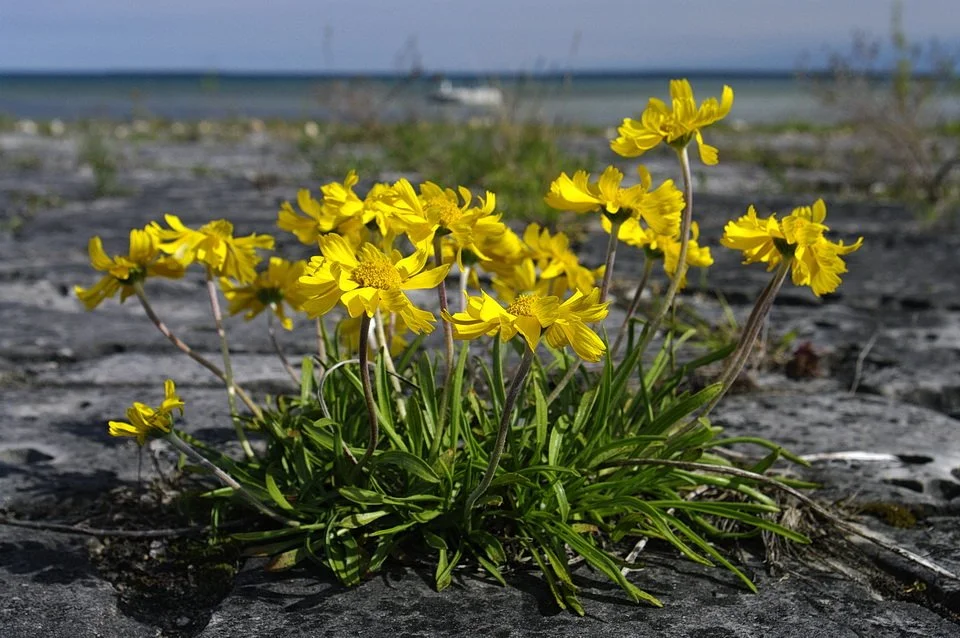
Photo 5: Lakeside daisy (Tetraneuris herbacea) growing on dolostone open alvar pavement, Belanger Bay, Manitoulin Island, Ontario, Canada. Image by Andy Fyon, June 6, 2009.
Many pioneers in geobotany and plant ecology, including Arthur Kruckeberg and Nishanta Rajakaruna, have emphasized that most edaphic factors are fundamentally controlled by the underlying geology (Rajakaruna et al., 2024). As a geologist by training and an amateur geobotanist, I am fascinated by this relationship because it illustrates how geology shapes the distribution, composition, and diversity of plant communities.
July 7, 2026
Quisque iaculis facilisis lacinia. Mauris euismod pellentesque tellus sit amet mollis.