Explaining Acid-tolerating Plants On Calcareous Bedrock, Manitoulin Island
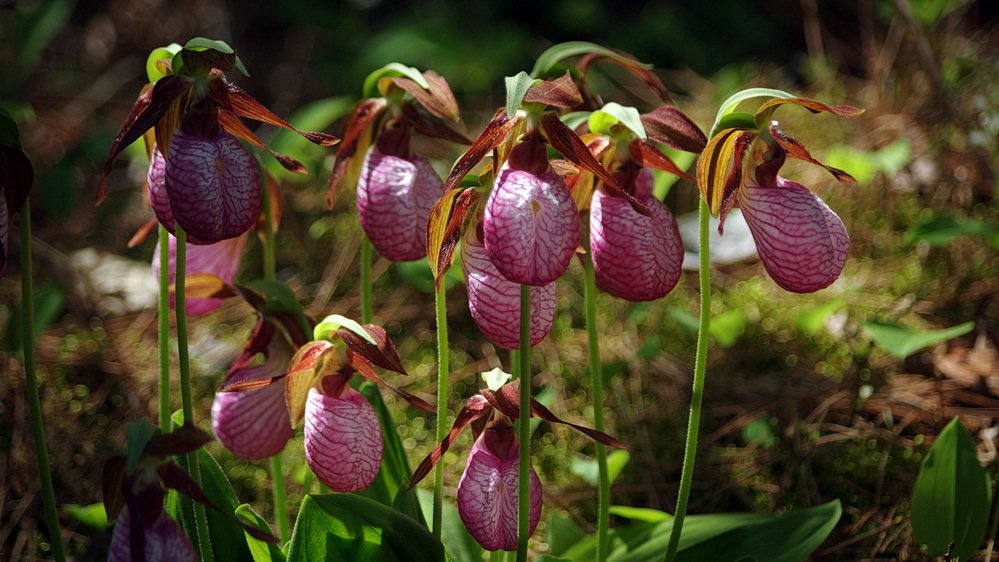
When I deliver a presentation on the influence of geology on the types and distributions of plant species, I usually show the distribution of Cypripedium acaule (pink lady's slipper: Photo 1) and Cypripedium parviflorum (yellow lady's slipper: Photo 2) across a part of Ontario that includes Manitoulin Island.

Photo 1: Cypripedium acaule (pink lady's slipper), an acid-preferring plant species, grows in an area of sandy, acidic soil in the Burnt Island alvar, Queen Elizabeth The Queen Mother Mnidoo Mnissing Provincial Park, Manitoulin Island, Ontario, Canada. Image by Andy Fyon, June 22/26.

Photo 2: Cypripedium parviflorum (yellow lady's slipper), a lime-loving calcicole plant species, grows in a moist back-berm area, on calcareous soil, on the Burnt Island alvar, Queen Elizabeth The Queen Mother Mnidoo Mnissing Provincial Park, Manitoulin Island, Ontario, Canada. Image by Andy Fyon, June 22/26.
There is a general separation between these two native orchid species that can be attributed to differences of bedrock geology. Cypripedium acaule tends to occur on the acidic Canadian Shield bedrock areas whereas Cypripedium parviflorum prefers limy calcareous geological bedrock areas. But, I always mention that the separation is "messy" and by no means perfect. Exceptions exist.
Exceptions Are Interesting
Exceptions are interesting because they beg for an explanation. For example, on Manitoulin Island, where the bedrock geology consists largely of dolostone and limestone, as of September 4, 2026, there are about 290 reported observations of the calcicole Cypripedium parviflorum on iNaturalist. Conversely, there are only 12 reported observations of Cypripedium acaule for the same area. I don't know how many individual plants each of these represents. Of the 12 Cypripedium acaule reports, the two that I have submitted come from part of the Burnt Island alvar, part of Queen Elizabeth The Queen Mother Mnidoo Mnissing Provincial Park. Both are associated with dry, sandy substrate forested primarily by Pinus banksiana (jack pine; Photo 3).

Photo 3: Pinus banksiana (jack pine) is common where sandy soil covers dolostone and limestone alvars. Photo composed on part of the Burnt Island alvar, within Queen Elizabeth The Queen Mother Mnidoo Mnissing Provincial Park, Manitoulin Island, Ontario, Canada. Image by Andy Fyon, June 22/26.
The Cypripedium acaule are accompanied by Cornus canadensis (bunchberry; Photo 4), Chimaphila umbellata (Pipsissewa; Photo 5), and Linnaea borealis (twinflower; Photo 6), all of which are considered to be calcifuge or at least tolerant of acidic soil.

Photo 4: Cornus canadensis (bunchberry), known to prefer cool, moist acidic soil, is growing in partial shade on sandy soil, in a forest dominated by Pinus banksiana (jack pine). Photo composed on part of the Burnt Island alvar, within Queen Elizabeth The Queen Mother Mnidoo Mnissing Provincial Park), Manitoulin Island, Ontario, Canada. Image by Andy Fyon, June 22/26.

Photo 5: Chimaphila umbellata (Pipsissewa) tolerates a wide range of soil acidity. Here it grows on sandy soil, in a forest dominated by Pinus banksiana (jack pine). Photo composed on part of the Burnt Island alvar, within Queen Elizabeth The Queen Mother Mnidoo Mnissing Provincial Park), Manitoulin Island, Ontario, Canada. Image by Andy Fyon June 22/26.

Photo 6: Linnaea borealis (twinflower), a species that prefers cool, acidic soil, is growing on sandy soil, in a forest dominated by Pinus banksiana (jack pine). Photo composed on part of the Burnt Island alvar, within Queen Elizabeth The Queen Mother Mnidoo Mnissing Provincial Park), Manitoulin Island, Ontario, Canada. Image by Andy Fyon, June 22/26.
How do we explain these two anomalous occurrences of Cypripedium acaule and its acid tolerating plant community which occur on an island of calcareous dolostone and limestone?
Decomposition Of Conifer Needles
I used to think that decomposition of conifer needles like Pinus banksiana created acidic soil and accounted for their local presence. However, research suggests that acidification from decomposition of conifer needles is a myth. So, rather than creating acidic soil, Pinus banksiana tracks it presence.
Forest Fires
Might the forest fire history of Manitoulin Island play a role in creating acidic soil? Anishinaabe oral history states that their original inhabitants abandoned and burned their settlements when they were driven out by Iroquois raids during the Beaver Wars during the mid-1600s. Great forest fires likely resulted, which were followed by fires in 1865 and 1890. Now, the relationship between forest fires and soil nutrients is complex, but forest fires tend to temporarily make soil more alkaline with the release of alkaline elements like calcium, magnesium, and potassium from the ash, at least for the short term immediately after the fire. However, that alkaline input is short-lived for porous, sandy soil that lacks organic matter or clay to retain the alkaline elements. Under those soil conditions, the alkaline elements are readily leached out by rain and melting snow, reversing the liming effect. Further, the loss of surface vegetation due to fire stops the recycle of alkaline elements from deeper soil, further enhancing the acidification of sandy soil.
So, the forest fire history of Manitoulin Island likely did not create the acidic habitats populated by acid-tolerant Cypripedium acaule, Pinus banksiana, Cornus canadensis, Chimaphila umbellata, and Linnaea borealis.
Leaching of Alkaline Elements
The more likely explanation for the presence of acid-tolerating plant community is the presence of the sandy, nutrient- and organic-poor soil substrate. Leaching of alkaline elements from that substrate created and sustained the local acidic soil habitat in what is otherwise an island of widespread calcareous soil on top of dolostone and limestone.
Cautionary Notes
I have not seen the other reported locations of Cypripedium acaule (pink lady’s slipper) on Manitoulin Island and therefore do not know if this suggested explanation applies to those occurrences as well.
Furthermore, this is one explanation to account for the presence of Cypripedium acaule on part of the Burnt Island alvar, Manitoulin Island. In reality, ecology and the edaphic influence on plant species distribution are complex and likely this explanation only partially accounts for the acid-tolerating plant community that includes Cypripedium acaule on Manitoulin Island.
Summary
The abundance of Cypripedium parviflorum on Manitoulin Island is consistent with the ubiquitous presence of calcareous limestone and dolostone.
Conversely, the anomalous and localized occurrences of acid-tolerating Cypripedium acaule, Pinus banksiana, Cornus canadensis, Chimaphila umbellata, and Linnaea borealis likely reflect pockets of sandy soil which have been leached of alkaline elements, creating the soil acidic.
The bedrock geology and surficial sand deposits, both formed by geological processes, are one explanation for the presence and distributions of acid-tolerating plant species on Manitoulin Island.
Sept 5/26.
Quisque iaculis facilisis lacinia. Mauris euismod pellentesque tellus sit amet mollis.